New York City

Botox Questions and Answers

How Does Botox Work?

Using Botulinum Toxin Type A Botox injections treat wrinkles via an injection. Botox was invented to treat neurological disorders, but today, it has been very successfully used in the treatment of wrinkles, frown lines, and crow’s feet.

How Is the Procedure Performed?

Botox is injected into the muscle tissue surrounding a wrinkle via a small needle. The discomfort is minimal and usually lasts a few seconds. Botox relaxes the muscle tissue by blocking nerve impulses to it. Within a couple of days the results can be clearly seen and will last for several months, after which the procedure can be performed again.

Am I Eligible to Receive Botox Injection?

Women who are pregnant or nursing should wait to have the procedure done, since the side effects associated with pregnancy are unknown at this time. Medication such as antibiotics, anti-inflammatories, and aspirin, will increase bruising. Younger people who have wrinkles but do not want to have a facelift are good candidates. As with all medical procedures, a consultation with a local cosmetic surgeon will help you find out if you are a candidate.

What Are the Side Effects of Botox?

Although Botox is relatively safe it does have some mild side effects. The most common side effects are temporary bruising, numbness, swelling, and a tingling sensation. Patients should not rub the area within the first 12 hours to help alleviate these side effects.

New York

Botox Injections

Who should consider a Botox injection?
What happens during the procedure?
What is the expected outcome of the procedure?
Initial consultation and testing
Follow-up care

Who should consider a Botox injection?
Anyone who has
  • Furrows or deep frown lines between the brows
  • Deep forehead lines
  • Crow’s feet around the eyes
What happens during the procedure?
Botox, or botulinum toxin, is a protein that when injected into specific muscles, relaxes them and prevents contraction, thus softening the associated wrinkles in the skin. Botox commonly is used for the treatment of frown lines between the eyebrows, forehead wrinkles, and crow’s feet around the eyes. The injections are given during a standard clinic visit and do not require any special preparation. There is no recovery waiting time and you may return to normal activity immediately. The injections will begin to take effect within 3–5 days and last from 3–6 months.

What is the expected outcome of the procedure?
The treated wrinkles around the forehead, eyebrows and eyes will become softer and more relaxed and the eyebrows will resume a more normal, less tense appearance.

Botulinum Toxin Injections

Botulinum Toxin Injections

Botulinum toxin injections (BTX), often referred to by the product names BOTOX® Cosmetic or Myobloc®, are biological toxins (botulinum toxin) transformed into a therapeutic agent. Work with BTX began in the late 1960s to treat neurological disorders. Today, BTX is used for the treatment of frown lines, forehead furrows, "crow's feet," lines and wrinkles of the lower face, and even nasal muscles (to decrease nostril flaring). BTX injections have proven to be a very popular nonsurgical cosmetic procedure; see current American Society for Aesthetic Plastic Surgery (ASAPS) statistics. Aesthetic plastic surgeons have found that the type of lines and wrinkles that respond to BTX injections are those caused by the muscles-specifically those muscles that contract during facial expressions such as frowning or squinting.

Contraindications

Contraindications

Botulinum toxin injections should not be used in pregnancy or when breast feeding. It is also inadvisable for those with certain neurological conditions such as motor neurone disease or myasthenia gravis.

Caution is necessary for patients on the following medications:

  • Aminoglycoside antibiotics (may increase effect of botulinum toxin).
  • Chloroquine and hydroxychloroquine (may reduce effect).
  • Blood thining agents eg. warfarin or aspirin (may result in bruising).

Occasionally the injection fails to result in the desired muscle weakness. The treatment can be repeated, but to reduce the chance of the development of neutralising antibodies, it is recommended that the treatment is not given again for two months.

Side effects and risks

Side effects and risks

Common Side Effects of Botox

Botox has been studied thoroughly in clinical trials. In these studies, the side effects that occur in a group of people taking the drug are documented and are then compared to side effects that occur in another group of people not taking the medicine. This way, it is possible to see what side effects occur, how often they appear, and how they compare to the group not taking the medicine.

In studies of Botox for cosmetic use (to improve the appearance of lines between the eyebrows), common side effects included:

Droopy eyelids -- in up to 3 percent of people

Nausea -- up to 3 percent

Muscle weakness -- up to 2 percent

Facial pain -- up to 2 percent

Indigestion or heartburn -- up to 1 percent

Tooth problems -- up to 1 percent

High blood pressure (hypertension) -- up to 1 percent.

In studies of Botox for treating medical conditions rather than for cosmetic purposes, the following common Botox side effects were reported:

Droopy eyelids -- in up to 20.8 percent of people

Difficulty swallowing -- up to 19 percent

Vertical misalignment of the eye (vertical deviation) -- up to 16.9 percent

Upper respiratory infection (such as the common cold) -- up to 12 percent

Neck pain -- up to 11 percent

Headache -- up to 11 percent.

Other common side effects (occurring in 2 to 10 percent of people) included:

Cough

Flu-like symptoms, such as a fever and chills

Back pain

Runny or stuffy nose

Dizziness

Soreness at the injection site

Weakness

Dry mouth

Drowsiness

Bleeding at the injection site

Infection

Sore throat

Anxiety

Bronchitis

High blood pressure (hypertension)

Nausea

Fatigue.

Botox Treatments

Botox treatment cannot only have a tremendous impact on today’s wrinkles, but it can also help prevent tomorrow’s wrinkles.

Botox works by relaxing the facial muscles that produce wrinkles. This can work to smooth lines today and to prevent lines from becoming permanent.

Facial muscle contraction such as smiling or frowning are one of the main causes of wrinkles. Because facial muscles are attached to the undersurface of the skin, a crease forms on the surface of the skin every time facial muscles contract to create an expression. When we are young (i.e. age 20) the skin returns to normal after a facial expression. Ultimately, however, the repetitive action of thousands of expressions over a lifetime produces permanent lines (wrinkles) that are considered a sign of old age. Botox treats these wrinkles better than any other single treatment other than surgery because Botox stops the root cause of these lines (i.e. muscle contraction). When Botox is started early, it is one of the best antiaging therapy available. Although procedures like collagen injections, fat injections, laser resurfacing, chemical peels, and surgery all help fix wrinkles, they are all repairing damaged skin that are related to sun damage. Botox can serve to stop the damage to the skin from occurring related to muscle contraction. Botox can prevent these muscles from creasing your skin every day over many years, therefore, it is logical to think that regular and repeated Botox treatments can prevent wrinkles from occurring that are related to muscle contraction.. If you already have wrinkles, regular and repeated Botox treatments over a period of two years or more may actually even improve these existing wrinkles that are related to muscle contraction.

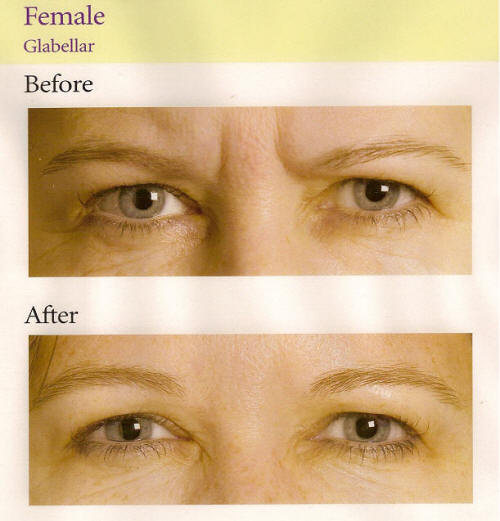
botoxglabellarboth_e1pw.jpg

Question & Answers about BOTOX®

Question & Answers about BOTOX®

How does it work?

It has long been observed that when a patient has a stroke that paralyzes one-half of their face, they lose the wrinkles on that same side of their face. For the treatment of wrinkles, a very dilute solution of BOTOX® is injected just under the skin into the overactive muscles producing the wrinkles. This blocks the impulses from the nerves to those muscles and produces a temporary muscle weakening, allowing the skin to regenerate and eliminate the lines.

When the muscles are kept under the influence of BOTOX®, they become shrunken (atrophic) and the BOTOX® effect starts to become more long lasting. The first BOTOX® treatment may last two to four months, but if the next treatment is given before the BOTOX® effect has significantly worn off, the second treatment will often last three to five months. With the third treatment, if given before the effects of the previous treatment have worn off, the effect tends to become even longer lasting. We've had patients come in saying "I had BOTOX® given a year ago, somewhere else, and it didn't work." A statement like this reflects a misunderstanding of the use of BOTOX®. We tell patients that to get optimal results they need to think of BOTOX® as a series of treatments, not just a one time or short term therapy.

frowning.jpg
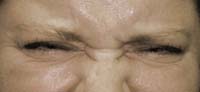
Frowning before BOTOfrowning.jpg
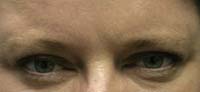
frowningafter.jpg
Frowning after BOTOX®

BOTOX® is used primarily to correct lines on the upper one-half of the face, particularly the frown lines, the forehead lines, and the crow's feet. These lines can add years to your appearance and can project a false impression of anger, concern or depression. BOTOX® can also be used to improve fine and deeper lines in the upper lip, the "downward smile" (the downward drooping of the corners of the mouth that occurs with aging), to improve the "gingival smile" (excessive gum show on smiling) and the creases and folds in the neck. BOTOX® has also been used to decrease the roll of muscle just below the lower lid margin and accentuated by smiling in some individuals. BOTOX® can also be helpful treating webbing of the neck and the transverse neck creases. Unfortunately BOTOX® cannot be used to correct lines that are not caused by muscle contraction, but in some of these instances Restylane and other fillers may be of help. At times fillers and Botox are administered at the same time.

BOTOX® acts to improve the line or crease by weakening the muscle that folds the skin. It is this repeated folding and unfolding that causes the crease. When the muscle activity stops the fold rapidly becomes less prominent because the skin tends to flatten out in the absence of muscle activity. However, the line in the skin remains initially. Fillers fill the fold, elevating it, but that does not stop the muscle activity. Sometimes BOTOX® and fillers will be used together in a single location, to produce more rapid initial improvement.