Question & Answers about BOTOX®
How does it work?
It has long been observed that when a patient has a stroke that paralyzes one-half of their face, they lose the wrinkles on that same side of their face. For the treatment of wrinkles, a very dilute solution of BOTOX® is injected just under the skin into the overactive muscles producing the wrinkles. This blocks the impulses from the nerves to those muscles and produces a temporary muscle weakening, allowing the skin to regenerate and eliminate the lines.
When the muscles are kept under the influence of BOTOX®, they become shrunken (atrophic) and the BOTOX® effect starts to become more long lasting. The first BOTOX® treatment may last two to four months, but if the next treatment is given before the BOTOX® effect has significantly worn off, the second treatment will often last three to five months. With the third treatment, if given before the effects of the previous treatment have worn off, the effect tends to become even longer lasting. We've had patients come in saying "I had BOTOX® given a year ago, somewhere else, and it didn't work." A statement like this reflects a misunderstanding of the use of BOTOX®. We tell patients that to get optimal results they need to think of BOTOX® as a series of treatments, not just a one time or short term therapy.
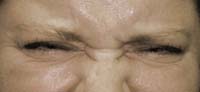 Frowning before BOTO X® |
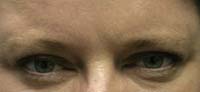 Frowning after BOTOX® |
BOTOX® is used primarily to correct lines on the upper one-half of the face, particularly the frown lines, the forehead lines, and the crow's feet. These lines can add years to your appearance and can project a false impression of anger, concern or depression. BOTOX® can also be used to improve fine and deeper lines in the upper lip, the "downward smile" (the downward drooping of the corners of the mouth that occurs with aging), to improve the "gingival smile" (excessive gum show on smiling) and the creases and folds in the neck. BOTOX® has also been used to decrease the roll of muscle just below the lower lid margin and accentuated by smiling in some individuals. BOTOX® can also be helpful treating webbing of the neck and the transverse neck creases. Unfortunately BOTOX® cannot be used to correct lines that are not caused by muscle contraction, but in some of these instances Restylane and other fillers may be of help. At times fillers and Botox are administered at the same time.
BOTOX® acts to improve the line or crease by weakening the muscle that folds the skin. It is this repeated folding and unfolding that causes the crease. When the muscle activity stops the fold rapidly becomes less prominent because the skin tends to flatten out in the absence of muscle activity. However, the line in the skin remains initially. Fillers fill the fold, elevating it, but that does not stop the muscle activity. Sometimes BOTOX® and fillers will be used together in a single location, to produce more rapid initial improvement.
